What a grade actually tells you
A climbing grade is a shorthand for how hard a route or problem is. It combines how difficult the moves are, how sustained they are, how big or small the holds are and sometimes how scary the climb feels. Grades are useful for choosing something at the right level, and for tracking progress, but they’re guides, not guarantees.
Different countries and disciplines use different scales. Indoors in the UK you’re most likely to meet the V-scale or Fontainebleau (Font) grades for bouldering, and French sport grades for roped routes. Some centres also use colour bands instead of numbers. Ask any member of staff how our problems and routes are graded and marked.
Bouldering grades
The V-scale (Hueco scale) starts at V0 and climbs upward: V1, V2, V3 and so on. The Font scale uses numbers and letters such as 4, 5, 6A, 6B and 7A, often with a plus sign for in-between difficulty. Roughly, they compare like this:
| V-scale | Font (approx.) | What it feels like |
|---|---|---|
| VB / V0 | 3 – 4 | Easy: big holds, simple moves. Great for beginners. |
| V1 – V2 | 5 – 5+ | Straightforward but more technical; you start to think about footwork. |
| V3 – V4 | 6A – 6B+ | Real puzzles; smaller holds and more powerful or balance-heavy moves. |
| V5 – V6 | 6C – 7A | Hard for most climbers; requires technique and strength. |
| V7 and up | 7A+ and up | Advanced, for experienced and dedicated climbers. |
These equivalents are approximate. Different centres, setters and climbers can disagree, and the same problem can feel different depending on your height, flexibility and style.
Roped climbing grades
For routes, the French sport grade is the most common system. It uses a number from 3 up, then a letter and sometimes a plus: for example 4, 5+, 6a, 6b+, 7a. Roughly:
- 3 – 4: easy; beginners, big holds, plenty of rests.
- 5 – 5+: beginner to intermediate routes with more thoughtful movement.
- 6a – 6b+: intermediate; sustained climbing with small holds.
- 6c – 7a: hard routes needing specific fitness and technique.
The grade of a route applies to the difficulty when you’ve learned how to climb it. A route graded 5+ might feel harder than a 6a if you haven’t learned the right sequence yet. That’s normal.
Colours and tags
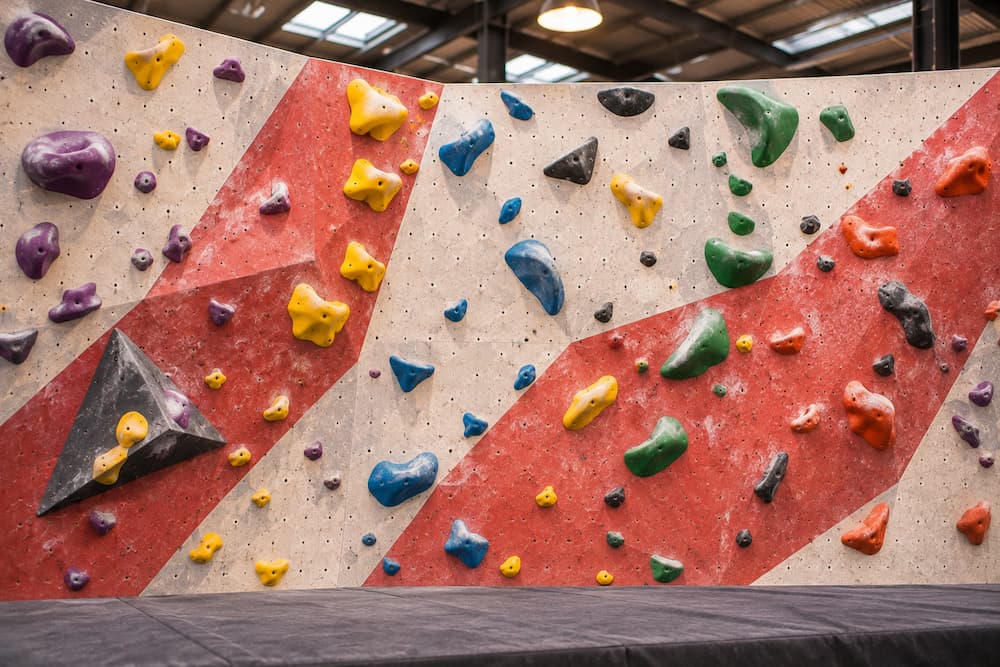
Many centres use hold colour or tags to show which holds belong to which route, and sometimes use colours as a simplified grading system. The meaning of the colours varies from centre to centre, so never assume. A colour band might cover a range of grades, such as a green for “VB–V1”. Ask staff how it works, and look for any notes at the base of the wall.
Using grades well
- Build a pyramid. Climb lots of easy problems, a fair number of medium ones and a few that stretch you. Your confidence grows from the base.
- Flash and repeat. Success on a grade means you can do it reliably, not just once. Repeating climbs teaches you movement.
- Don’t chase numbers. The best climbers enjoy climbing at all grades. Variety makes you stronger and more adaptable.
- Mix styles. Slab, vertical and overhang climbing use different skills. A V3 slab may feel nothing like a V3 overhang.
Top tip
If you flash most of the climbs at a grade, try the next one up. If you’re not finishing any, drop down a grade and focus on movement. Both are good practice.
Why grades disagree
Grades are an opinion based on consensus. A problem that’s “hard for the grade” may suit a tall climber and be a nightmare for a shorter one. Setters can only guess how climbs will feel for everyone. Some centres grade conservatively and others generously, so a V3 at one centre might feel like a V2 or V4 somewhere else.
So treat the grade as a rough guide. If a climb feels easier or harder than the number, don’t worry. The best measure is whether you’re enjoying it and learning.
Practise it with us
Reading about climbing helps, but instruction makes it stick. Try a beginner session, join an adult class or ask about private coaching. These guides are general information and are not a substitute for instruction: always follow the centre rules and staff instructions.